
You're standing in a store holding two cushion covers. One says "eco" on the tag in a soft green font. The other says nothing at all. The one with the label costs $18 more, feels thinner, and the stitching is visibly uneven. Everything in you says grab the cheaper, sturdier one and move on. And honestly? That instinct isn't wrong as often as the marketing wants you to believe.
I've furnished three apartments in the last decade, and somewhere around the second one I got tired of being sold "conscious living" in a burlap wrapper. So I started keeping a running list of what actually holds up, what's actually lower-impact, and what's just a word printed on a hangtag. That list is what follows — sustainable decor materials to look for when shopping, filtered through what I've bought, returned, and occasionally regretted.
Key Takeaways
- Material origin matters less than end-of-life: ask what happens to the piece in 10 years, not where the fiber was grown.
- Certifications beat adjectives. GOTS, FSC, and OEKO-TEX are checkable; "natural" and "green" are not.
- Solid wood, linen, cork, wool, and reclaimed metal age well. Bonded particleboard wrapped in veneer does not.
- Secondhand is almost always the lowest-impact option — and the cheapest way to get better materials than you could afford new.
- If a store can't tell you what a product is made of, that silence is your answer.
- A single well-made piece you keep for 15 years beats five trendy ones you replace every three.
What actually makes a decor material sustainable
Here's the uncomfortable part: almost nobody defines this the same way twice. Some brands mean recycled content. Some mean biodegradable. Some mean "we planted trees." All three claims can be true and still describe a product that ends up in a landfill within four years.
The framing that finally clicked for me was switching from origin to lifecycle. Where a material comes from is one question. What it does afterward is the one that decides whether it belongs in your home.
The four questions I run through before buying anything
- Can I repair it? A chair with screws and replaceable cushions passes. A sofa with foam glued to the frame fails.
- What is it when it dies? Wool, linen, cork, and untreated wood break down. Polyester blends and composite boards mostly don't.
- Is the claim verified? Third-party certification, or a vague word on a tag?
- Will I still want this in five years? The most sustainable object is the one you don't replace.
Notice that "is it organic" isn't on that list. That's deliberate. Organic cotton grown, dyed, and shipped across an ocean can carry a heavier footprint than conventional cotton bought from a workshop two towns over. I'm not saying certification is pointless — I'm saying it's one input, not the whole answer.
What are eco-friendly decorative materials?
Eco-friendly decorative materials are those with a low impact across their whole life: renewable or recycled feedstock, minimal processing, no toxic finishes, and a realistic path back into the ground or the recycling stream when you're done with them. The term covers fibers, metals, woods, and finishes alike — and it does not automatically mean "expensive," which is the assumption that keeps people buying plastic they didn't want.

Fibers that earn their place
Linen is the one I'd defend hardest. Flax grows with very little irrigation, the whole plant gets used, and the fabric gets softer for years instead of pilling apart. A linen throw I bought four winters ago has outlasted two acrylic ones that cost nearly as much.
Wool, particularly undyed, is another one. It regulates temperature, resists dirt, and doesn't need frequent washing — which quietly cuts the energy cost of owning it. The catch is sourcing. Ask whether the wool is recycled or virgin, because the two carry very different footprints.
Organic cotton deserves a mention but with a caveat I learned the expensive way. I once paid a premium for an organic cotton rug that shed fibers for eight months and then flattened permanently. Organic and durable are separate properties. Check both.
Hard materials, and why reclaimed wins
On the structural side, FSC-certified wood, cork, and reclaimed metal are the ones I keep coming back to. Cork regenerates from bark that grows back without killing the tree. Reclaimed metal has already absorbed its extraction cost. FSC timber means the forest was managed, not clear-cut.
The material I avoid now is bonded particleboard — the stuff inside most flat-pack furniture. It's resin-heavy, it swells if it gets wet, it can't be sanded back, and it essentially can't be recycled. It's the single most common material in affordable decor, and it's the one with the shortest honest lifespan.
What are the most sustainable materials for interior design?
The most sustainable materials for interior design are the ones that combine three properties at once: renewability, durability, and a viable end-of-life. That combination is rarer than any single trait. Bamboo regrows in years, but a bamboo floor finished with a heavy polyurethane coating is no longer a low-impact product. Durability without recyclability gives you a chair that lasts 40 years and then sits in a landfill for another 400.

Ranked by how they actually perform over a full lifecycle, here's where the common options land:
| Material | Renewable? | Typical lifespan | End-of-life | Watch out for |
|---|---|---|---|---|
| Solid FSC wood | Yes, managed | 20–50 yrs | Repairable, often reusable | "Solid wood" labels on veneered cores |
| Linen | Yes | 10+ yrs | Compostable if undyed | Blends sold as pure linen |
| Wool (recycled) | Recycled | 15+ yrs | Compostable, or re-felted | Anti-moth chemical treatments |
| Cork | Yes, bark regrows | 10–20 yrs | Compostable | Cheap cork crumbles under moisture |
| Reclaimed metal | Already extracted | Decades | Highly recyclable | Unknown alloy content |
| Bonded particleboard | No | 3–7 yrs | Practically none | Resin binders, moisture damage |
| Virgin polyester | No | 5–10 yrs | Sheds microplastics | Sold as "easy care" |
Two rows in that table cost me real money to learn. The particleboard desk that swelled after a spilled glass of water, and the "linen" curtains that turned out to be 60% polyester once I read the fiber content on the back of the package. The front label said linen. The back label told the truth.
What are the most eco-friendly materials?
If you want the shortest honest answer: reused materials beat new ones, and untreated natural materials beat treated ones. A secondhand oak table outperforms a new "sustainable" pine one on almost every metric, because the biggest environmental cost of furniture is the manufacturing and transport, and that cost is already paid.
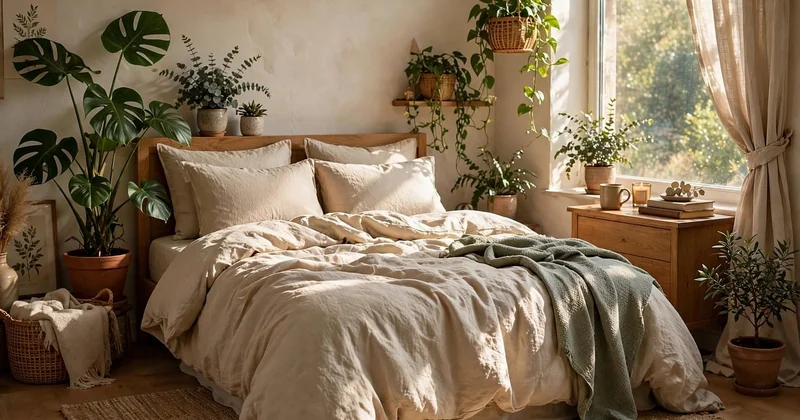
Beyond reuse, the materials with the strongest case are wool, linen, cork, bamboo, reclaimed wood and metal, and glass. Glass is worth calling out because it's endlessly recyclable without quality loss and it doesn't off-gas. The tradeoff is weight and shipping emissions — a reminder that no material is flawless.
The certifications worth actually checking in the store
- GOTS — for organic textile fibers, covers the whole supply chain, not just the farm.
- FSC — for wood and paper, confirms the forest was responsibly managed.
- OEKO-TEX Standard 100 — tests for harmful substances in finished textiles. Useful for anything touching your skin.
- B Corp — a company-level certification, not a product one. It tells you about the business, not the specific item in your hand.
I know that's a lot of acronyms to hold in your head while shopping. A practical shortcut: if a product carries no certification at all and the brand's sustainability page is mostly photography, assume the claim is decorative.
Is bamboo really as sustainable as people say?
Bamboo grows fast and needs little water, which is genuinely good. The problem is processing. Turning bamboo into soft fabric usually involves a chemical-heavy viscose process, and bamboo flooring is often laminated with adhesives. Raw bamboo — cutting boards, small furniture, structural pieces — keeps the advantages. Highly processed bamboo loses most of them.
Does buying secondhand actually count as "sustainable decor materials"?
Yes, and it's arguably the strongest version of it. The material is already manufactured, so the extraction and production impact is sunk. What matters is whether you're extending that item's life or just delaying its trip to the dump. Buying secondhand and keeping it for years is the whole point.
What is the 3-5-7 rule in decorating?
The 3-5-7 rule is a styling guideline for arranging accessories: group items in odd numbers — typically three, five, or seven — at varying heights and sizes within a single display. Three items form a simple triangle. Five lets you vary height more. Seven gives a shelf or mantel a sense of fullness without looking cluttered.
It's a proportion trick, not a rule about materials. But it connects to sustainability in a way that took me a while to notice: odd-number groupings let you build a display from mismatched, secondhand pieces instead of a matched set you buy all at once. A ceramic vase from a flea market, a wooden bowl inherited from a relative, and a candle in a reused glass jar read as intentional precisely because they don't match.
Using the rule to buy less
Most people treat the 3-5-7 rule as a shopping prompt — you need seven things, so you go buy seven things. Flip it. Use it as a constraint that forces you to shop your own home first.
When I restyled my living room last year, I applied the rule to a shelf I'd been meaning to "finish" for two years. I pulled three pieces I already owned, found two more in a storage box, and bought exactly nothing. The shelf looked better than the version I'd been planning to spend about $200 on. That's the pattern worth repeating.
A five-minute checklist for the store
All of this collapses into something you can actually do while standing in an aisle with your phone in one hand.
- Read the fiber content label, not the front of the package. The back tells the truth.
- Look for a certification mark, and treat the absence of one as information.
- Lift the piece. If it's suspiciously light for its size, it's probably composite.
- Check whether the cover comes off and whether the frame can be tightened or repaired.
- Ask the staff what happens to the product at end of life. The pause before the answer is telling.
Shopping for sustainable decor is less about memorizing a list of approved materials and more about developing a reflex — a habit of asking one extra question before you hand over your card. Which brings up the part most guides skip: the most sustainable material in the room is usually the thing you already own.
The best purchase I made in the last two years was a repair, not a product: $40 to reupholster two dining chairs I'd been about to replace with a set that would have cost around $600 and lasted maybe a third as long. The new ones would have arrived with a sustainability page. The old ones just needed a stapler and an afternoon.
So the next time you're holding two cushion covers and one of them is whispering about the planet, don't reach for the green font. Turn both over. Read the back. Then decide which one you'll still be happy with in a decade — because that question, asked honestly, tends to answer the other one on its own.