Bringing French Country Style Into a Modern Home Without Turning It Into a Theme Park
The first time I tried to mix French country into a modern apartment, I ended up with a room that looked like a prop house for a period drama. Toile everywhere. A ceramic rooster. A distressed armoire that was three inches too tall for the ceiling and scraped the paint every time I opened it. I spent roughly $1,400 building a set, not a home. That was the lesson: French country style isn't a shopping list. It's a set of proportions, materials and light, and once you understand those, you can drop it into a glass-and-steel box and it still works.
Key Takeaways
- French country style lives in material and imperfection, not in motifs — reclaimed oak, limestone, washed linen, aged brass
- In a modern home, you keep the modern bones (windows, kitchen lines, lighting) and let the rustic layer sit on top
- The rule of thumb I use: roughly a third of a room should feel aged, two-thirds should feel current
- Budget matters: you can get 80% of the effect for 20% of the cost if you spend money only on the pieces you touch
- The fastest way to make it dated is to repeat a farmyard motif more than once in a room
- Skip the full renovation. Layer, live with it for a month, then adjust
What "French Country Style" Actually Means When You Strip It Down
Most people picture lavender fields and rooster-printed tea towels. That's Provence tourism, not interior design. The real thing comes from farmhouses in the south of France that were never decorated on purpose — they were built from whatever was local, and patched over decades because nobody had the money to redo them properly.
That's the whole aesthetic. Local materials, visible repair, and a refusal to be symmetrical.
The three materials that carry the style
If you get these right, you can leave almost everything else modern:
- Limestone or pale stone — floors, fireplace surrounds, a single countertop. Cool, matte, slightly uneven.
- Raw or reclaimed oak — beams, a dining table, a shelf. Not orange. Not lacquered.
- Washed linen and raw cotton — curtains, slipcovers, bedding. It should look like it's been through the wash fifty times.
Add aged brass or black iron for hardware and you have the entire vocabulary. Everything else — the ceramics, the baskets, the dried flowers — is decoration on top of a structure.
Why "French Country" and "Modern French" are different things
This trips people up constantly. Classic French country is rural, rough, and unapologetically imperfect. Modern French — the version you see in newer builds — takes that rustic base and pairs it with something sharp: a slab-front kitchen, a frameless glass shower, a black steel window. The tension is the point.
Honestly, modern French is the easier of the two to live with today, because it doesn't demand that your whole house commit to a personality.
How to Layer French Country Into a Modern Home, Room by Room
Here's where I'd start. Not with the living room — everyone starts with the living room and it turns into a showroom.
Start with the kitchen
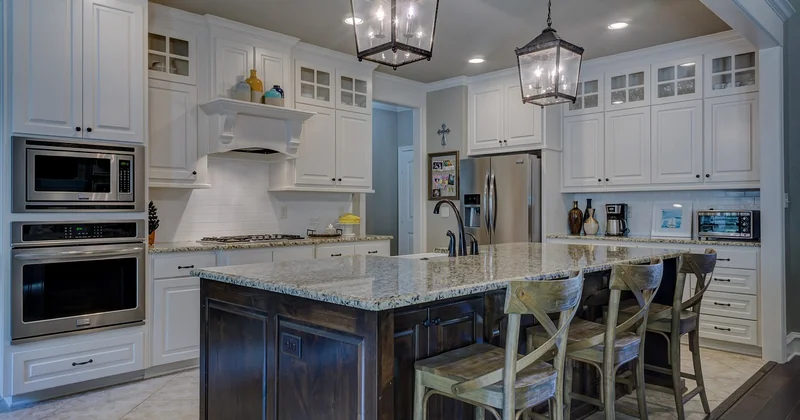
A modern French country kitchen is the highest-return room in the house, and it's the one where the mix reads most clearly. Keep your flat-panel cabinetry and work triangle exactly as they are. Then change three things:
- Swap the hardware for aged brass or matte black iron pulls. Cost, in my experience: $4–12 per pull. Total for a normal kitchen, a few hundred dollars.
- Replace the backsplash with a hand-made glazed tile that has slight color variation across each piece. Machine-perfect tile kills the effect.
- Get one piece of stone that's visibly veined or fossil-rich for the island, and let the perimeter counters stay quiet.
What you don't do: hang copper pans on a rack you'll never use, paint the cabinets sage green and then add a farmhouse sink and a barn door and open shelving with three matching crocks. That's the theme park trap. Pick two gestures and stop.
The bedroom is where it gets personal
Bedrooms are forgiving because nobody performs in them. A modern French country bedroom is basically a modern bedroom with better textiles and one antique.
My formula: plain white or off-white walls, a bed with no visible branding, a washed linen duvet in a muted tone, and exactly one genuinely old piece — a nightstand, a small bench at the foot of the bed, a framed mirror with silvering that's starting to spot. The spotted mirror is the whole trick. New mirrors reflect too perfectly and the room reads contemporary-cold.
I made a mistake in my first attempt here: I bought a matched pair of antique nightstands. Symmetry killed it. Two mismatched pieces, similar height, different wood tones, felt instantly more French and more relaxed.
The Budget Conversation Nobody Has
Search "French country" and you get photos of rooms that cost more than most people's cars. Here's what I actually spent, on a 60 m² apartment, spread over about five months:
| Element | What I did | Approximate cost |
|---|---|---|
| Kitchen hardware | Replaced all 14 pulls with aged brass | $130 |
| Lighting | Two antique brass wall sconces, rewired | $220 |
| Textiles | Washed linen curtains (2 windows) + duvet cover | $410 |
| One antique | Late-19th-century oak sideboard, unrestored | $650 |
| Ceramics and small things | Four pieces, mostly from markets | $90 |
| Total | No structural work, no painting, no flooring | ~$1,500 |
The antique sideboard was the single best purchase. Not because it's beautiful — it's scratched and one drawer sticks — but because everything modern around it immediately reads as intentional rather than cheap.
Where to spend and where to save
Spend on the things your hands touch and your eyes rest on: hardware, one light fixture, the fabric on the sofa or the bed, and one old piece. Save on everything else. Nobody has ever walked into a room and said "this basket is poorly made."
I'll be blunt: I have bought cheap "vintage-style" ceramic jugs that looked fine in the shop and looked like a chain hotel by the third week. If it's mass-produced and pretending to be antique, it usually shows.
What Actually Makes French Country Style Look Dated
It's not the style. It's the repetition and the finish.

The four tells of a pastiche
- Motifs on repeat. One rooster is charming. Three roosters, two lavender sprigs, and a sunflower stencil is a diner.
- Toile on more than one surface. Curtains yes, and maybe nothing else. Toile on the walls and the bedding and the lampshade is a period piece.
- Uniform distressing. Real age is random. Factory distressing appears in identical locations on every unit.
- Warm yellow everything. The 1990s Provençal look was built on butter yellow and terracotta. In a modern home it fights every cool grey and white surface you have.
Here's the thing most guides won't say: French country done well in a modern house is quieter than the modern house around it. It should feel like the furniture has been there longer than the walls.
What About the Outside — French Country Style House Exterior?
If you're working with an existing modern exterior, you're not going to change the building's architecture, and you shouldn't try. What you can do is soften the transition.
Modern French country exteriors in newer builds usually get there through three moves: a steeper roofline with a visible gable, a mix of stone and painted render rather than one flat material, and windows that are taller than they are wide with a divided-light pattern. If your house already has clean rectangular windows, adding black or dark grey steel-look frames actually pushes toward the modern French reading rather than away from it.
At ground level, limestone paving, a low boxwood hedge, and one climbing plant against the wall will do more than any facade change. I have seen people spend $30,000 on a stucco redo and get less atmosphere than a $600 gravel-and-lavender border.
Frequently Asked Questions
Can you mix French country style with a modern minimalist interior?
Yes, and it's the combination that ages best. Minimalism gives you the empty space that makes a single antique or a piece of raw oak feel important. The mistake is filling that empty space back up with small decorative objects. Keep the surfaces clear, and let one old thing carry the room.
Is French country style still in style?
The rural-imperfection version never really left, because it's built on materials that don't go out of fashion. What goes in and out is the decorative layer — the roosters, the yellow walls, the matching sets. If you invest in stone, oak and linen and treat the accessories as disposable, you're insulated from the cycle entirely.
How much does it cost to add French country style to a modern home?
You can get a convincing result in one room for a few hundred dollars if you focus on lighting hardware, fabric and a single old object. A whole-house approach with new flooring and stonework runs into five figures quickly. Most people, in my view, get more satisfaction from the smaller version done slowly than from one big renovation done all at once.
Should I paint my walls warm colors?
No — or at least, not yet. Modern homes have cool light coming through large windows, and warm walls under cool light turn muddy. Start with white or bone, add warmth through wood and fabric, and only then consider a warmer wall tone. I've watched people paint a room terracotta and then spend the next two years trying to light it correctly.
The Thing That Took Me Longest to Learn
You can't buy your way into this style. What makes it work is that the pieces have a reason to be there — they're worn because someone used them, uneven because someone made them by hand, mismatched because the household grew over time.
So if you take one thing from all of this, let it be the slowness. Buy the sideboard in March. Live with it. Notice what the room is missing in June. Add the linen in September. By next year you'll have a house that looks like it arrived at French country by accident, which is precisely how the real ones did.
And if you're tempted to buy the ceramic rooster — put it back. There's one in my storage unit that's been waiting for three years for a home that will never come.