
You lay down a 5'x8' rug in a 12x14 living room, push the sofa back against the wall, and something looks off. The rug floats. The sofa looks orphaned. You can't name what's wrong, but you feel it every time you walk in. Nine times out of ten, it's not the rug itself—it's the size.
Choosing the right rug size for every room is where most people lose the plot, and I get it. The rug is usually the last thing you buy, after the paint, the sofa, the lighting. It feels like an accessory. It isn't. It's the thing that decides whether a seating area reads as a real room or a pile of furniture someone left behind. Get the size wrong and no amount of expensive furniture fixes it.
Key Takeaways
- The furniture rule matters more than the room's square footage: front feet on the rug is the safe default, all four feet is the luxury move.
- The band of bare floor you leave around the rug should usually sit between 18 and 24 inches—less in small rooms, more never.
- A rug that's too small is the single most common mistake, and it can't be fixed with styling.
- Measure your furniture first, then your floor. Not the other way around.
- Non-rectangular rooms, open plans and sectionals each have their own logic—copying a standard size chart will fail you.
Why rug size decides the room before color or texture ever does
Color is what you notice in a photo. Size is what you notice in real life.
Here's the mechanism, and it's simple enough that once you see it you can't unsee it. A rug draws a boundary. Everything sitting on it becomes part of one group. Everything off it becomes a separate island. When you lay a small rug in the middle of a big seating arrangement, you've essentially told the room that the coffee table is a group and the sofa and chairs are strangers loitering nearby. That's why a perfectly nice rug can make a room feel unfinished.
The opposite works just as fast. When a rug runs under the front feet of the sofa and the chairs and stops a sensible distance from the walls, the eye reads a defined zone. Conversation area. Done. You haven't moved a single piece of furniture.
The acoustic thing nobody tells you
Hard floors bounce sound. A rug absorbs it. In an open room with wood or tile, going from no rug to a properly sized one is the difference between a space that rings and a space you can actually talk in at normal volume. I've watched this flip a dining room from "echoey and slightly stressful" to normal with nothing but a correctly sized flatweave. No acoustic panels. No furniture changes.
The visible floor band is your real measuring stick
Most guides tell you to leave 18 to 36 inches of bare floor between rug and wall. I'd narrow that. In a typical room, aim for 18 to 24 inches. Below 12 inches it starts to look like a fitted carpet you meant to install wall to wall. Above 30 inches and the rug shrinks visually, no matter how big it actually is. The band is what makes a rug feel intentional rather than leftover.
How to measure before you buy (the step nobody actually does)
I'll be honest: the first time I bought a rug, I ordered the size that looked right in the product photo. It arrived, I unrolled it, and I stood there doing math in my head about return shipping. That rug is now in a hallway.

Do this instead, and it takes twenty minutes.
- Measure the furniture, not the room. For a sofa plus coffee table plus two chairs, measure the outer footprint of the whole grouping—from the back of the sofa to the front edge of the chairs.
- Add your overhang. Add 6 to 12 inches on each side beyond the furniture footprint so the rug extends past the group instead of stopping inside it.
- Check it against the room. Now measure your floor. If your calculated rug leaves less than 12 inches to the wall, go down a size. If it leaves more than 30, go up.
- Mark it with tape. Lay painter's tape on the floor at the exact edges of the size you're considering. Live with it for two days. This one step saves more money than any calculator.
- Walk the traffic paths. Make sure people can get around the seating group without stepping off the rug and back on. They will anyway, but it shouldn't feel like hopping tiles.
That tape trick is the closest thing to a real rug size calculator you'll get, because it accounts for your actual room rather than a generic ratio.
Rug size for a living room: the apartment problem
Apartments break the standard size charts, and almost nobody admits it.
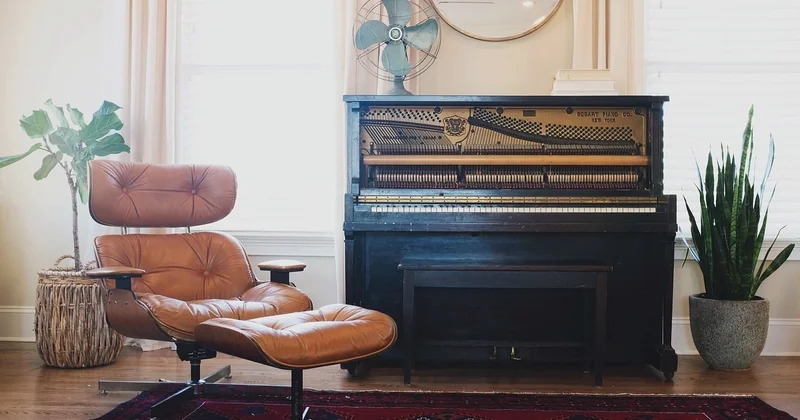
A 9'x12' is the default "living room" size in most guides. Put that in a 12x14 apartment living room and you'll have about a foot of floor on every side—technically correct, visually claustrophobic, and you'll spend the rest of your lease moving furniture in tiny increments hoping it stops bothering you.
Smaller rooms want a smaller rug with a tighter furniture arrangement. In a compact living room, a 5'x8' or 6'x9' usually does the job if you pull the sofa off the wall and float the seating group. Yes, off the wall. I know it feels strange the first time. It gives the rug room to define the zone, and the room suddenly has a center.
What size rug for a living room with a sectional?
Sectionals are the hardest case, because an L-shape has two long sides and the rug has to satisfy both. The rule that holds: the rug should run under the front legs of both arms of the L, and ideally tuck a few inches past the corner. For most sectionals, that means a 9'x12', and in larger rooms a 10'x14'. A 8'x10' can work with a small sectional in a small room, but only if the chaise section sits entirely on the rug rather than hanging off the edge like a diving board.
If your sectional is genuinely too big for any standard rug, two smaller rugs laid side by side is a legitimate solution, not a compromise. Just keep the pile height identical on both or the seam will look like a mistake.
Rug placement in a living room with a TV
The TV doesn't change the rug size. It changes the orientation.
Anchor the rug to the seating group facing the TV, not to the TV itself. The screen is a wall object; the rug belongs to the people. If the TV sits on a media console, the console can sit on the rug or just in front of it—either works—but the sofa and chairs must be the ones the rug is measuring against. I've seen people stretch a rug toward a TV console and leave the sofa half off the edge, and the whole thing reads backwards.
Rug size for a bedroom: where the rules quietly invert
Bedrooms want something different from living rooms. You're not grouping furniture around a conversation—you're grounding a bed.
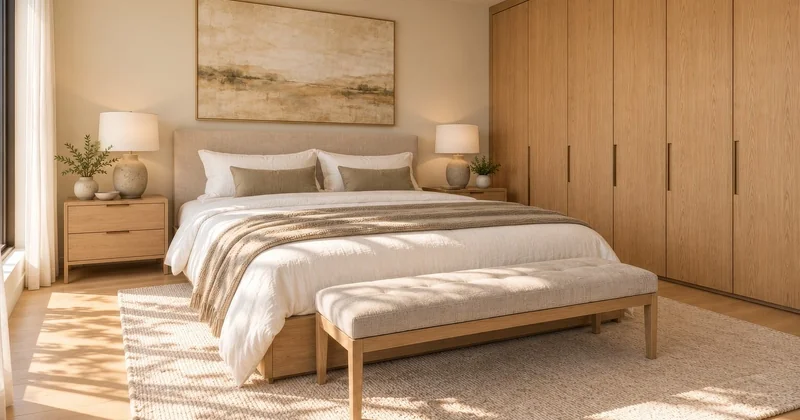
- Queen bed, generous room: an 8'x10' or 9'x12' running under the lower two-thirds of the bed, extending 18 to 24 inches on each side.
- Queen bed, tight room: a 5'x8' placed sideways at the foot, or two runners on either side if you can't fit one rug.
- King bed: 9'x12' is usually the floor, and a 10'x14' isn't excessive in a large primary bedroom.
- Kids' rooms: err smaller and softer. A 5'x8' under the bed leaves play space and survives spills better than a wall-to-wall commitment.
The one mistake I see constantly: a rug placed entirely in front of the bed like a landing strip. It looks like a bath mat that escaped. Either run the rug under the bed or commit to runners on the sides—don't do the runway.
Dining rooms, kitchens and entries: the sizes people get wrong most
The dining room rule is unforgiving and easy to remember: the rug must extend at least 24 inches beyond every edge of the table, so chairs stay on the rug when pulled out. Get this wrong and every meal becomes a game of catching a back leg on the rug's edge.
| Room | Furniture | Rug size that usually works | Non-negotiable rule |
|---|---|---|---|
| Living room (small) | Sofa + 2 chairs, floating | 5'x8' or 6'x9' | Front feet on the rug |
| Living room (standard) | Sofa + chairs + coffee table | 8'x10' or 9'x12' | All front feet on, 18–24" floor band |
| Living room with sectional | L-shaped sectional | 9'x12' or 10'x14' | Both arms' front legs on the rug |
| Dining room | Table + 4–6 chairs | Table size + 24" on all sides | Chairs stay on when pulled out |
| Bedroom (queen) | Bed + nightstands | 8'x10' or 9'x12' | Extends 18–24" each side |
| Entry | Door + walkway | Runner, 2'6"–3' wide | Longer than the door swing |
Entries and hallways want runners, typically 2'6" to 3' wide, and the length should clear the door's swing plus a couple of feet. Kitchens are the one room where a rug is optional—if you cook seriously, a washable mat in front of the sink beats a decorative rug you'll resent within a month.
L-shaped rooms and open plans: when the size chart stops helping
Open-plan living and dining areas are where the standard advice falls apart entirely.
The answer isn't one giant rug. It's usually two rugs, one per zone, sized so they visually belong to each function without competing. Living zone gets a 9'x12', dining zone gets a rug sized to its own table plus 24 inches. Leave a strip of bare floor between them—that gap is what tells the eye these are two rooms sharing a space.
For L-shaped rooms, treat the L as two rectangles and size a rug for each arm rather than trying to force one rug into the corner. Trying to cover an L with a single rectangle always leaves one leg of the L feeling undressed.
What about round and oval rugs?
Rounds work best in square-ish spaces and under round tables. Size them by diameter: a round dining rug should be your table's diameter plus 48 inches. In a living room, a round rug under a single armchair or a small reading nook is lovely; under a full sofa-and-chairs grouping it rarely works, because the curve leaves the corners of your furniture hanging in space.
The things you forget until delivery day
Size is the decision. These are the practicalities that decide whether you regret it.
- Weight and doorways. A large wool rug can weigh well over 60 pounds and won't bend through a tight stairwell well. Measure your narrowest passage before ordering.
- Underfloor heating. Wool and most natural fibers are fine over most modern systems, but thick rubber-backed rugs block heat and can cause hot spots. Check with the rug's maker and your heating installer here—this is worth a real phone call, not a guess.
- Rug pad. Always. It stops sliding, adds life to the rug, and makes a thin rug feel considerably more expensive than it was.
- Budget scales with size, not linearly. Doubling the area more than doubles the price in most cases, because you're buying wall-to-wall material cut down.
- Returns. Large rugs are expensive to ship back. That tape-on-the-floor test exists precisely so you never have to.
One thing I'd push back on: the idea that you should always buy the biggest rug you can afford. In a genuinely small room, an oversized rug with no floor band left visible makes the space feel like it's wearing a shirt two sizes too big. Proportion beats square footage every time.
Measure your furniture. Tape the floor. Live with the outline for two days. Then buy the rug that fits the room you actually have, not the one in the size chart—because the rug was never really about the floor. It's about telling everyone, including yourself, where the room begins.