Curved furniture and soft shapes: why your next sofa probably won't have a single sharp corner
Walk into three furniture showrooms in the same afternoon and you'll notice something odd. The sofas are round. The armchairs have no edges. The coffee tables look like river stones. A decade ago, the same stores were selling you blocks—hard angles, straight backs, square everything. Now the sharp stuff is in the clearance corner, marked down.
This isn't a marketing mood. It's a real shift in how curved furniture and soft shapes have moved into modern homes, and it's been building for long enough that it's no longer a trend you can wait out. I've furnished two apartments in the past few years, and the second one taught me something the first didn't: curves aren't just prettier. They change how a room actually works.
Key Takeaways
- Rounded sofas, arched openings and boucle chairs signal comfort and reduce visual hardness, but they cost more and eat floor space.
- The curve revival traces back to the 1970s, resurfaced through post-pandemic nesting, and hardened once minimalism felt cold to live with.
- Materials matter: bent wood, moulded foam and rattan curve naturally; MDF and cheap veneers fight the shape and crack.
- Two or three curved pieces per room is usually the ceiling. Past that, the space reads as a themed set.
- Small rooms don't have to skip the trend—rounded-back chairs and oval tables work better than a full round sectional.
Why curves came back, and why they're not leaving
Straight lines had a good run. For roughly two decades, the dominant interior look was a grid: right angles, flat surfaces, everything aligned to a wall. It photographed beautifully. Living in it was another matter.
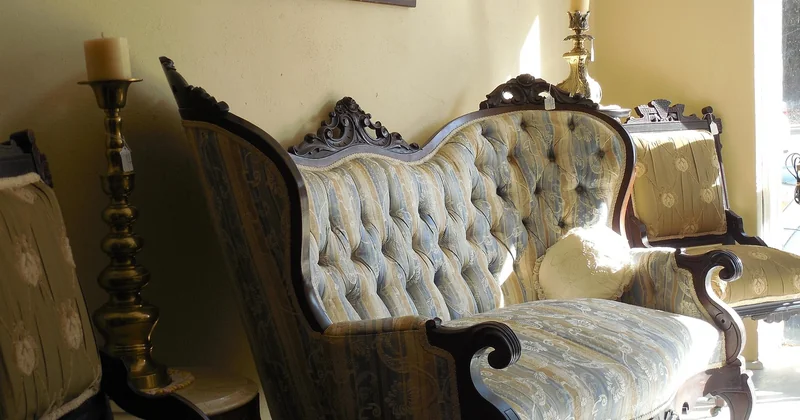
The shift started, as these things usually do, with tiredness. People who had spent years in white-and-grey rooms began craving something the eye could follow. A curve does that—your gaze travels around it instead of stopping at a corner. That's the honest reason arches, rounded sofas and organic tabletops took over: they're easier on the nervous system than a room made entirely of boxes.
A seventies callback, minus the shag carpet
The current wave borrows heavily from 1970s interiors—the round chairs, the warm woods, the conversation pits. But it strips out the heavy browns and the shag. What's left is the geometry. Designers kept the curve and ditched the era's texture pile-up.
There's a second driver that doesn't get enough credit: post-pandemic nesting. When home became the office, the gym and the restaurant, people stopped treating their living room as a backdrop and started treating it as a place to spend eighteen hours a day. Hard-edged furniture stopped feeling appropriate.
Here's the part I'd push back on. Plenty of write-ups frame this as purely emotional—curves are warm, curves are welcoming. That's half true. The other half is practical: a rounded sofa corner is a corner you don't bang your hip on. When I swapped a square coffee table for an oval one, my shins thanked me within a week. Sometimes the trend and the ergonomics point the same direction.
What curved furniture actually costs you
Nobody selling you an arched console mentions the trade-offs. So let's do it.
The space math nobody shows you
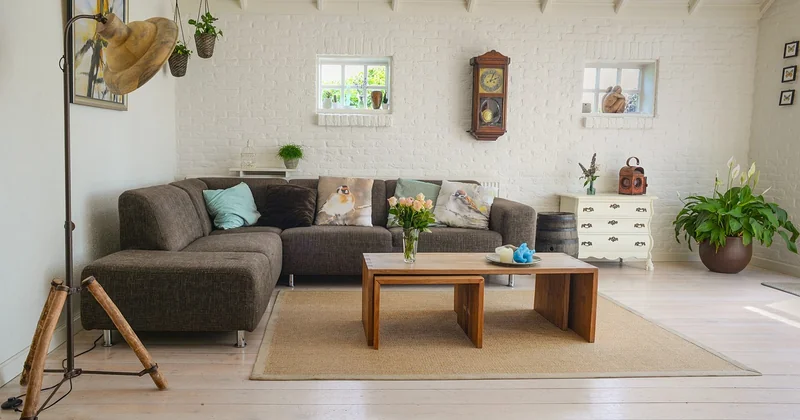
A curved sofa typically needs more clearance than a rectangular one of the same seat count. Why? Because the widest point of the curve is in the middle, not the ends. You lose the ability to tuck it flush into a corner. In my current living room, a 2.2-metre round-back sofa leaves a dead zone behind it—roughly a third of a square metre that I can't put anything in.
On a floor plan, that's nothing. In a 28-square-metre apartment, it's the difference between a walkable path and a shuffle.
The cost premium is real
Curved pieces cost more, and it isn't price gouging. Bending wood, moulding foam into a continuous back, or upholstering a shape with no straight lines all take more labour than assembling a box. Expect to pay somewhere between 20% and 50% more for a comparable curved sofa than a rectangular one at the same quality level. That gap narrows once curved designs become standard catalogue items, and it has narrowed noticeably in the last couple of years.
The catch? Cheap versions of the trend are worse than no trend at all. A low-cost curved sofa built on a rectangular frame with padding stuffed into the corners will flatten out within eighteen months. I watched a friend's bargain round chair sag into an unhappy pancake before its second birthday.
Storage and layout limits
Round furniture doesn't line up. That sounds like a minor annoyance until you're arranging a bookshelf next to an oval table and realise nothing wants to sit parallel to anything else. Curved pieces also tend to have fewer internal compartments—a bowed sideboard holds less than a rectangular one of the same footprint, because the curve steals depth at the ends.
If storage density is your priority, curves are working against you. Fine. Say it out loud and design around it.
How to mix curves and straight lines without it looking like a showroom set
The mistake I made on my first attempt was going all in. Rounded sofa, round side table, oval mirror, arch-shaped shelf. The result felt less like a designed room and more like a themed café. My partner's exact words: "It looks like we're waiting for a table."

The fix is proportion, not commitment.
The two-to-three rule
In a typical living room, two or three curved elements is enough to shift the whole mood. Pick the biggest object first—usually the sofa—then add one or two smaller curves. Everything else can stay angular without fighting the effect.
- A curved sofa with a rectangular coffee table and square shelving: works, calm, no visual noise.
- Straight sofa with a round armchair, an arched floor lamp and an oval side table: works too, and it's cheaper.
- Round sofa, round rug, round table, round mirror, round cushions: stops working the moment you add the fifth circle.
Anchor the curve with something solid
Curves float. Without a straight line to push against, they lose their effect entirely. A rounded chair in front of a rectangular window or beside a squared-off bookcase reads as a deliberate choice. The same chair dropped into a room where everything is soft just reads as mush.
My rule of thumb after two apartments' worth of trial and error: for every curved piece, keep at least two straight-edged ones nearby. That ratio has held up in a large living room and in a cramped one.
Materials that bend, and materials that break
Not every material wants to be a curve. Some surrender gracefully. Others crack, warp, or telegraph the shape badly after a year.
| Material | How it handles curves | Upkeep | Cost bracket |
|---|---|---|---|
| Bent wood (steam-formed) | Excellent—the grain follows the shape | Wipe, occasional oil | High |
| Moulded foam with fabric | Very good for seating, holds shape well if density is high | Vacuum, spot clean | Mid to high |
| Rattan and cane | Naturally curved, lightweight | Keep dry, avoid direct sun | Low to mid |
| MDF with veneer | Poor—curves tend to look pasted on | Delicate; chips easily | Low |
| Solid stone or composite | Good for tabletops, heavy | Seal periodically | High |
The question to ask before you buy
If you're buying a curved upholstered piece, ask about foam density. This is the single number that decides whether the curve survives year three. The salesperson may not know it offhand—that alone tells you something.
Bent wood is the opposite case: expensive, slow to produce, and the only material where the curve genuinely reads as structural rather than applied. A bent-wood chair costs more because it has to be, not because it's fashionable.
Does this work in a small space?
Yes, with a caveat. The pieces that fail in tight rooms are the big round sectionals—they need breathing room on all sides, which small apartments don't have. The pieces that work well are the ones where the curve is in the profile, not the footprint.
Rounded-back dining chairs tuck under a table just as easily as square ones. An oval table seats the same number of people as a rectangular one of similar length while making the room feel less crowded, because your eye never hits a sharp corner in the traffic path. Arched floor lamps occupy almost no floor space and do more for the room than most furniture.
What I'd avoid in a small apartment: round coffee tables over 90 cm, curved sofas with a deep chaise, and anything described as a "conversation piece." Conversation pieces need a room to be a piece in.
Will curves still be here in five years?
Almost certainly, and for a reason that has nothing to do with taste cycles. The straight-line era depended on cheap, flat, mass-produced panels—and that manufacturing logic is being replaced. Bent wood, moulded foam and 3D-formed composites are getting cheaper to produce every year. The economics now favour the curve.
That doesn't mean the current look survives unchanged. The heavy boucle everything phase is already thinning out. What will remain is the underlying shift: rooms designed around how they feel to move through, not just how they look from the doorway.
My own living room is somewhere in between the two eras, and honestly, that's the honest place to land. Two curved pieces, a lot of straight lines, one dead zone behind the sofa I still can't figure out what to do with. If you're standing in a showroom right now deciding whether to commit, my advice is smaller than you'd expect: buy one curve. Live with it for a month. The room will tell you whether it wants a second.