Creating a low maintenance backyard garden that actually stays low maintenance
A neighbour once asked me why my backyard looked "done" when hers looked like a construction site. Same street. Same clay soil. Same brutal July heat. The difference wasn't effort—she was out there every weekend and I wasn't—it was that I'd stopped treating my garden like a hobby and started treating it like a piece of infrastructure. That shift, made after two seasons of watching plants die because I forgot to water them, is what I want to walk you through here.
Creating a low maintenance backyard garden isn't about finding plants that never need anything. Nothing living works that way. It's about designing a system where the plants, the soil, and the layout do most of the work instead of you. Get that right and you'll spend a few hours a season on upkeep rather than a few hours a week. Get it wrong and you'll be watering, weeding, and replanting forever.
Key takeaways
- Kill the lawn first. Grass is the single most demanding thing in a typical backyard—mowing, edging, watering, feeding.
- Match plants to your soil and light conditions, not to what looks pretty at the nursery. "Right plant, right place" beats any fertiliser.
- Mulch heavily and permanently. A 3-inch layer cuts watering by more than half in my experience and starves most weeds of light.
- Hardscaping is expensive upfront and cheap forever. Grass is the reverse.
- Group plants by water need so your irrigation zones make sense.
- The first year always looks sparse. That's normal. Resist the urge to fill gaps with fast growers you'll regret.
The cheapest way to make your garden low maintenance
If you want the honest answer: stop buying plants. The cheapest move is almost always subtracting, not adding.
Here's what I mean. When I redid my own back border, I pulled out about 40 square feet of grass, laid down cardboard (free, from a local shop), covered it with a thick layer of wood chips from a tree surgeon who was happy to dump a load rather than pay disposal fees, and waited one season. Total cost: zero. That bed now supports drought-tolerant perennials and needs maybe twenty minutes of attention a month.
What actually costs money, and what doesn't
The expensive parts of a low-maintenance garden are the hard elements—paving, retaining walls, a proper drip line. The cheap parts are mulch, compost, and patience. Most people spend in exactly the wrong order: they buy mature shrubs at £40 a pop and skip the mulch that would have kept them alive.
- Free or nearly free: cardboard sheet mulching, wood chip mulch from arborists, division of existing perennials, seed from a neighbour's garden
- Worth paying for: a drip irrigation timer, quality landscape fabric under gravel paths, one good pair of pruners
- Not worth it early on: decorative stone, raised beds made from new timber, anything labelled "instant"
And the water bill matters more than people expect. A traditional lawn in a hot climate can drink hundreds of litres a week through summer. Swap it for gravel, mulch, and established shrubs and that demand drops to almost nothing once the plants are rooted.
What is the 3-5-7 rule in landscaping?
The 3-5-7 rule is a planting guideline for arranging groups of plants in odd-numbered clusters: three of one species, five of another, seven of a third, repeating them through a bed. The idea is that odd numbers look natural to the eye while even numbers read as deliberate and stiff.
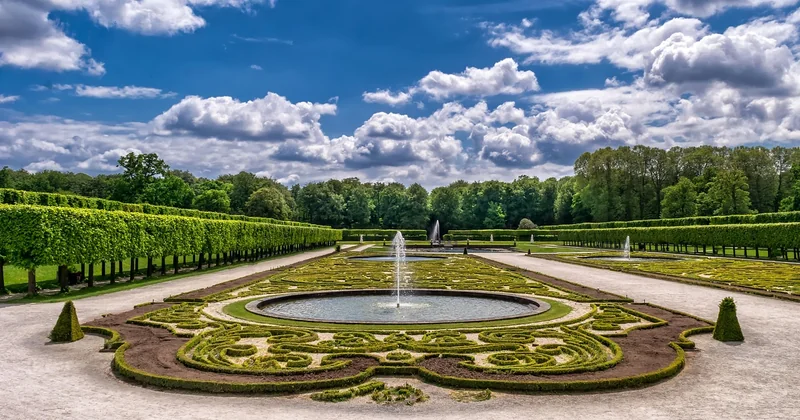
In practice it's a useful starting point, not a law. I use it loosely. What matters more is repetition—the same plant appearing in several places ties a border together and makes it look intentional rather than random. When I first started, I planted one of everything. It looked like a botanical sample sale. Grouping in threes and fives fixed that in a single season, and, conveniently, grouped plants are easier to water and mulch because they form one mass instead of twelve scattered dots.
A caution: the 3-5-7 rule applies to perennials and shrubs, not to trees, and not to tiny groundcovers where you'll want dozens. Don't force it where it doesn't fit.
What is the 70/30 rule in gardening?
Two versions circulate, and both are worth knowing. In planting design, the 70/30 rule means roughly 70% of your plants should be the reliable backbone—evergreens, structural shrubs, tough perennials—and 30% can be the seasonal, colourful, higher-maintenance extras. If you flip that ratio, you've built a garden that demands constant attention.
The other version applies to hardscaping: about 70% soft planting to 30% hard surfaces, or the reverse depending on who you ask. The principle underneath is the same—balance, so the space doesn't look like a car park or a jungle.
For a low-maintenance garden, I'd push even further: 80/20. Most of what you plant should be able to survive a fortnight of neglect without dying. The remaining fifth is your reward for the effort you do put in.
What is the 5-4-3-2-1 gardening method?
This one is a planting-layer formula: five or more groundcover plants, four mid-height perennials, three structural shrubs, two small trees or large feature plants, and one focal point—a sculpture, a specimen tree, a water feature. It's essentially a recipe for a layered bed that reads as complete from any angle.
I tried this on a 6-by-4-metre bed and it worked better than I expected, mostly because it forced me to think vertically instead of just scattering things at the same height. The catch is that "one focal point" is harder than it sounds. I went through three before settling on a simple corten steel planter, and the first two looked like someone had abandoned furniture in my garden.
Use the formula as scaffolding. If your space is small, drop the trees and keep the layers compressed.
Design choices that cut work for years
The decisions that save the most time are made before you plant anything.
Rethink the lawn
Lawn is the default and it's also the most labour-intensive surface you can own. You don't have to remove all of it—a small patch for sitting on is fine—but shrinking it is the single highest-return change you can make. Replace the edges with mulch beds, gravel, or low groundcover and your mowing time drops immediately.
Get the soil right, once
Compacted, lifeless soil is why plants struggle and why you end up watering constantly. Breaking it up and adding organic matter in year one means roots go deeper and survive dry spells on their own. I skipped this on my first bed and spent two summers hand-watering things that should have been independent.
Irrigate by zone, not by plant
Group plants with similar water needs together and run one drip line per group. It sounds fussy; it isn't. It means you set a timer and forget it, rather than standing outside with a hose guessing.
Comparison: upfront cost vs ongoing effort
| Surface or feature | Upfront cost | Ongoing effort |
|---|---|---|
| Lawn | Low to moderate | High—weekly mowing, watering, feeding |
| Gravel with mulch beds | Moderate | Low—occasional topping up |
| Paving or decking | High | Very low—sweep and forget |
| Perennial border | Low if you divide plants | Low once established |
| Annual flower beds | Low each year | High—replanting, deadheading, watering |
The pattern is consistent: anything you build once and maintain rarely beats anything you replace every season.
Mistakes that cost me two summers
I'll be blunt about what didn't work, because most guides skip this part.
- Planting thirsty species next to drought-tolerant ones. The thirsty ones won, the tough ones rotted.
- Using landscape fabric under mulch. Weeds grew on top of it and the fabric made them impossible to pull cleanly.
- Buying "low maintenance" plants without checking the mature size. Three years later I was digging out shrubs that had swallowed a path.
- Watering little and often. Deep, infrequent watering builds roots that find their own water. Shallow daily watering builds plants that depend on you forever.
None of these were expensive mistakes. They were just slow ones—each took a full season to become obvious.
What "low maintenance" really looks like over a year
After the establishment phase, my own garden takes me roughly two hours a month through the growing season and almost nothing from November to February. That's cutting back spent perennials in spring, topping up mulch once, and clearing a few weeds that always find the gaps. A conventional lawn-and-annuals garden on the same plot would run closer to ten or twelve hours a month.
The first year is the expensive one in time, not money. You're planting, mulching, and waiting. Year two it starts to hold itself together. Year three you wonder why you ever did it any other way.
So here's the thought I'd leave you with: the goal was never a garden that needs nothing. It's a garden that only needs you when you feel like showing up—and that, honestly, is a much better reason to walk outside.